
GUIDES · MAY 7, 2026 · BY DAVID MELNYCHUK
How to Fix a Drafty Front Door: 7 Fixes From Ten Bucks to a New Door
You feel it in the hallway in January: a cold ribbon of air sliding across your ankles from the direction of the front door. A drafty front door heats the porch nicely, but the porch does not pay rent, and the air leaking around a door is heated air you already paid for, leaving the building.
The right fix is almost never the expensive one first. Here are the seven fixes we actually use, ordered from a ten dollar strip to a full replacement, with real prices for each rung and the honest signs that tell you when climbing higher is worth it.
First, find the leak: two tests that cost nothing
Do not buy anything yet. Close the door on a dollar bill at a dozen spots around the perimeter: latch side, hinge side, top, bottom. If the bill slides out with no resistance at any spot, that is a leak. Second test: on a windy day, move a stick of incense or a lit candle slowly around the closed door and watch the smoke. Where it dances, air moves.
Where the leak lives tells you the fix. Latch side or top leaks point to weatherstripping or a door that is not pulling tight. Bottom leaks point to the sweep or threshold. Daylight visible at a corner points to a sagging or warped door. Ten minutes of testing routinely saves people a $4,000 door they did not need.
- Bill slides out on the latch side or top: weatherstripping or strike adjustment
- Bill slides out along the bottom: sweep or threshold
- Daylight at a corner: sagging hinges or a warped slab
- Leaks everywhere at once: shot weatherstripping, and possibly a door at the end of its life
Fix 1: replace the weatherstripping, $10 to $30
The compressible gasket around your door frame does the actual sealing, and after 10 or 15 years of compression cycles it is flattened, cracked, or torn. Most doors made since the 1980s use kerf mounted weatherstripping: a flexible bulb with a fin that presses into a slot in the frame. You pull the old strip out with your fingers and press new material in with no tools. Measure the old profile, take a sample piece to the store, and buy the matching type.
This one fix cures the majority of drafty doors we get called about. If we come out and all your door needs is a weatherstrip kit, we will tell you that on the phone and save both of us the visit.
Fix 2: add or replace the door sweep, $15 to $40
The sweep seals the gap at the bottom of the door slab. Old ones lose their flexibility or get torn up by decades of dragging over the threshold. A screw on sweep with a vinyl or brush fin installs in 15 minutes: close the door, hold the sweep so the fin just kisses the threshold along its full length, and drive the screws through the slotted holes so you can fine tune it.
The mistake people make is setting the sweep too low, which makes the door drag and eventually tears the sweep. Light, even contact is the goal, not a squeegee.
Fixes 3 and 4: square the door in its frame, free to $10
A door that does not pull snug against the weatherstripping leaks no matter how new the gasket is. Two adjustments fix most of these. First, the strike plate: if the latch clicks in but the door still rattles when you push it, the strike is letting the door rest short of the seal. Many strikes have an adjustable tab you can bend outward with a screwdriver, or you can move the plate a sixteenth of an inch toward the seal.
Second, the hinges: an uneven gap around the door, tight at the top latch corner and wide at the bottom, means the door has sagged. Replace one short screw in the top hinge with a 3 inch screw driven into the framing behind the jamb. It pulls the hinge and the door back up square. If needed, a strip of cardboard shim behind a hinge leaf tunes the gap. Total cost: one screw.
One more free habit while you are at it: throw the deadbolt whenever the door is closed. A deadbolt pulls the slab hard against the weatherstripping in a way the latch alone never does, and on a marginal seal that alone kills a surprising amount of draft.
- Rattling door with a working latch: bend or move the strike plate
- Uneven gap, door rubs at one corner: 3 inch screw in the top hinge
- Door sits too deep or too shallow in one spot: shim a hinge leaf
Fix 5: adjust or replace the threshold, $20 to $150
Many door thresholds have an adjustable cap: four or five screws along its length raise or lower the cap to meet the door sweep. If you can see daylight under the door, try a half turn on each screw before buying anything. A worn out threshold, cracked cap, rotted wood core, costs $50 to $150 in parts to replace, and this is the one bottom of door fix where hiring it out makes sense, because the threshold has to be bedded in sealant correctly or you trade a draft for a leak that rots the subfloor. We charge a standard small job visit for it, and it beats replacing a floor.
While you are down there, check the wood just inside the threshold. If the flooring or subfloor at the door feels spongy, water has been getting past the threshold for a while, and that repair belongs on the list before winter regardless of drafts. Wet subfloor at an entry is one of those $150 problems that becomes a $1,500 problem quietly.
Fix 6: add a storm door, $650 to $1,200 installed
A storm door does not fix a leaky entry door, but it parks a wall of still air in front of it, and still air is a decent insulator. On older entry doors, especially attractive original wood doors you do not want to replace, a storm door takes the edge off winter and adds screen season in the summer. Around here storm door installs generally run $700 to $1,300. Ours typically land at $650 to $1,200 because the same crew that installs your door handles it without a second mobilization.
The caveat: on a south or west facing entry with no porch roof, heat builds between a storm door and the entry door on sunny days, hot enough to warp vinyl and blister dark paint. Full sun entries are usually better served spending the money on the entry door itself.
Fix 7: replace the door, $2,200 to $5,500 installed
Sometimes the door is simply done. The honest signs: rot you can probe at the bottom rail or the jamb, a slab so warped that no strike adjustment closes the gap, a single pane of glass or no insulation in the slab, or daylight at a corner that comes back every winter no matter what you adjust. Old wood doors also shrink and swell seasonally, which is why the door that seals in July whistles in January.
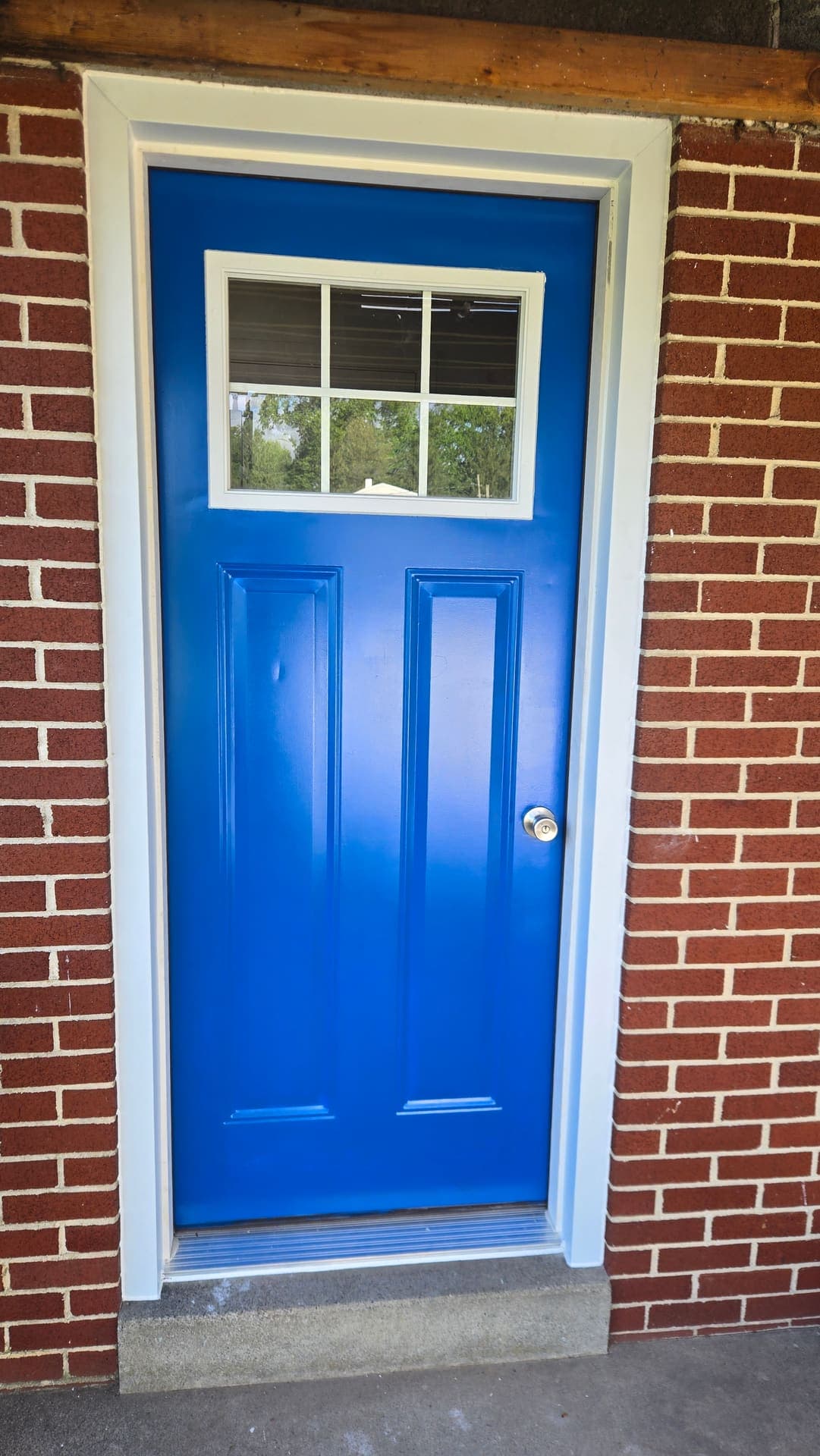
A modern insulated fiberglass or steel entry door with a proper frame, sill pan, and continuous weatherstripping is a different product category from what most 1970s houses got. Look for ENERGY STAR rated doors for our climate. Around Lancaster County a quality entry door professionally installed runs about $2,400 to $5,900. Our installs typically land at $2,200 to $5,500 because one in-house crew does demo, framing repair, install, and trim in one pass. You can see the difference a full replacement makes in our Coatesville rowhome entry door project and this blue entry door in Denver.
The winter math, and the honest bottom line
Heating season here runs a good five months, and air leakage is one of the larger controllable slices of a winter heating bill. A quarter inch gap along the bottom of a 36 inch door is roughly a 9 square inch hole in your wall. Nobody would tolerate a hole the size of a brick in the living room wall, but that is what a bad sweep is.
The honest bottom line: start at the bottom of this ladder. Most drafty doors are cured for under $50 by fixes 1 through 5, and anyone who quotes you a new door without checking the weatherstripping first is selling, not diagnosing. When the slab itself is rotted, warped, or uninsulated, replacement is the fix that actually ends the problem, and our window and door installation crew does it year round, winter included. A door swap takes us most of a day, and your opening is never left open to the weather.
Questions we hear a lot
Why is my front door only drafty in winter?
Cold makes everything worse at once. Wood and vinyl shrink, gaskets stiffen and seal less, and the temperature difference between inside and outside drives air through gaps harder. A marginal seal in October is a whistling one in January. Fix it on a mild day and test it on a windy one.
How much does it cost to fix a drafty front door?
Usually under $50. Weatherstripping runs $10 to $30, a sweep $15 to $40, and strike or hinge adjustments are effectively free. A threshold repair is a small service visit. Replacement, at $2,200 to $5,500 installed, only makes sense when the door itself is rotted, warped, or uninsulated.
Will a storm door stop the draft?
It reduces it by creating a buffer of still air, but it does not fix the leak. Seal the entry door first with the cheap fixes, then add a storm door if you want the buffer, the screen season, or protection for a wood door you love.